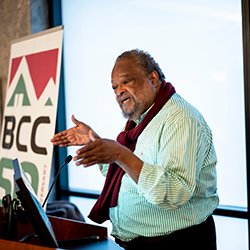
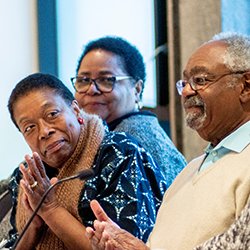
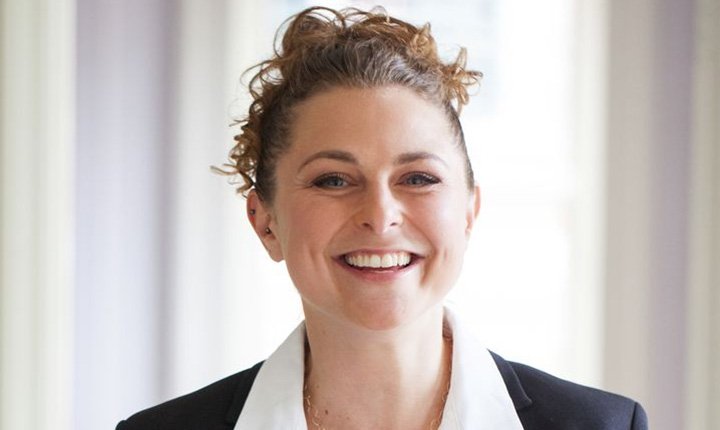
Swarthmore College President Rebecca Chopp grew up in rural Kansas and was among the first in her family to attend college. In this Class Awareness Month event, Rosario Paz '10 interviews President Chopp who shares her experiences of navigating various - and sometimes contradictory - social and cultural spaces in her journey through higher education from her student days to the present. She also took questions from students, faculty, and staff, shedding further light on the complex process of social mobility and identity.
Alumni, parents, and friends joined President Rebecca Chopp for a conversation about intellectual engagement, support for others, and simply having fun at the College during the Chicago Listening Tour event. President Chopp noted that students at the College are truly supportive of one another, and while that often means engaging in rich intellectual discussions, it also means showing up for soccer matches, theater events, and parlor parties to support their peers in a wide variety of extracurricular activities. Of course, underpinning all of the fun and social engagement lies a deep, enduring tradition of intellectual rigor at the College. President Chopp shared "I've encountered it in conversations with students enthusiastic about their honors seminar discussions and seen it in the faces of faculty members who light up when asked about the experience of teaching at this fine institution."
Dom Sagolla '96 (@dom), co-founder of Twitter, spoke on campus about his new book, 140 Characters: A Style Guide for the Short Form (@thebook) and demonstrated the companion iPhone app (@bookapp). He encouraged the audience to think of short, 140 character Twitter updates as a new form of literature and to "lead" as a writer in the short form rather than be a follower. The medium is "there to empower you," he said. He engaged the audience in a discussion about topics ranging from the demographics of social networking to how Twitter impacts personal relationships.
Sagolla graduated from Swarthmore with a degree in English Literature and later obtained a Masters in Education from Harvard. He has contributed to Macromedia Studio, Adobe Creative Suite, and Odeo. Currently, he works at DollarApp, an iPhone app development company.
President Rebecca Chopp heard from alumni spanning diverse career paths and age groups at the San Francisco Listening Tour event. Together, they discussed the vital importance of critical thinking as a part of a Swarthmore liberal arts education, the efforts of the Office of Career Services, and ensuring that the community confronts the Swarthmore "bubble" and thinks critically about itself. President Chopp said in regard to careers and a Swarthmore education, "If we really make sure that students are educated to think well, to think critically, they will find their paths."
Rita Dove, Pulitzer Prize winner, National Humanities Medalist, and former U.S. Poet Laureate, gave a reading on campus as part of the Cooper Series. She indulged the audience by reading several requested poems and sharing the stories that inspired them as well as a bit about her writing process.
President Rebecca Chopp recently addressed members of the class of 2012, sharing with them her ideas of how they might make the best use of their sophomore year. She encouraged students to learn about, as well as from, other's passions, noting that "exploring, navigating, and cultivating intellectual passion is the special work of the sophomore year."
She shared that experiencing other people's passions is one of the great joys of her job as president and she celebrated the accomplishments of several alumni she's met since joining the Swarthmore community. President Chopp also suggested that students might learn from the faculty's life experiences, when she said "even as you study the subjects that the faculty teach you, study the faculty as exemplars of passionate living."
President Rebecca Chopp recently visited the nation’s capitol to meet with the alumni, parents, and friends of the College as part of her Listening Tour. The conversation was a rich exchange of ideas, including a discussion about the role of the College as a leader in higher education. President Chopp said, "As stewards and beneficiaries of the finest undergraduate education in the world, we have an obligation to contribute to the broader national discussion about the nature of education, its intrinsic value, and the role that liberal arts colleges can, and must play, in helping forge a more just society."
At her first Listening Tour event, President Chopp says she came away from the evening "impressed – and not the least bit surprised - by the thoughtfulness of Swarthmore alumni, family, and friends and encouraged by the support and enthusiasm for the college, and for my new role here."
In more than a dozen future events, and in general, she adds she is "particularly eager to gain insight into which aspects of the Swarthmore experience should endure; what values we most treasure; and how those values can help shape our decisions as we look forward to the future together."
Peggy Seeger was a special guest at Swarthmore's 2009 Alumni Weekend. She gave a talk titled "Scalpels or Sledgehammers? Music as a Tool for Activism." Her visit was organized by Swarthmore Folk, a group of alumni interested in carrying forward the tradition of folk music on the campus.
In giving the 2009 Bernie Saffran Lecture, noted economist Alice Rivlin H'76 examines the policy challenge of addressing capitalism's downsides without destroying the productivity of the market-based economy.
Currently a senior fellow at the Brookings Institution and a professor at Georgetown University, Rivlin is the founding director of the Congressional Budget Office and is an expert on urban issues as well as fiscal, monetary, and social policy. She has served as the director of the White House Office of Management and Budget in the first Clinton Administration and as vice chair of the Federal Reserve Board .
The Bernie Saffran Lecture is named for an economics professor who taught and mentored generations of Swarthmore students until his death in 2004.